
Author name: Anthropos India Foundation

Past Events, Uncategorized

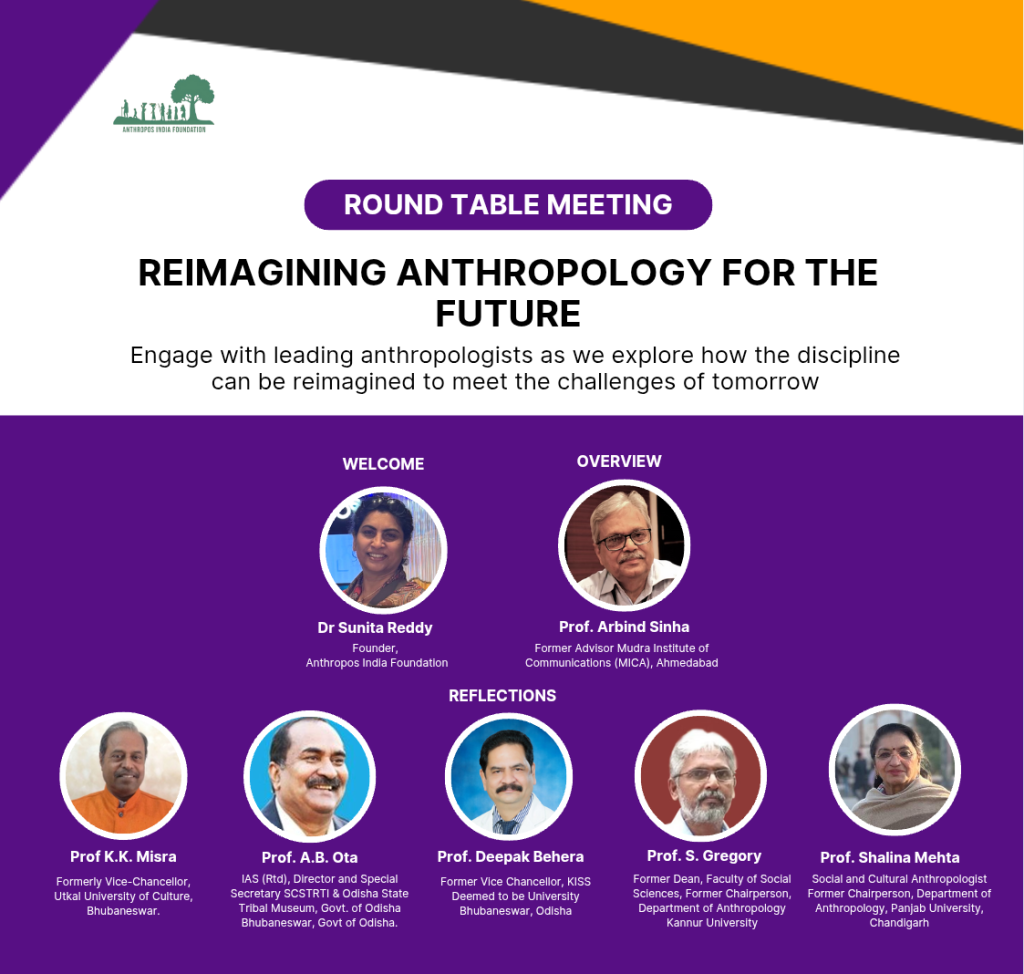
REIMAGINING ANTHROPOLOGY FOR THE FUTURE | ROUND TABLE MEETING | AIF | 23 September 2025

The lecture “From Insight to Impact – Anthropology’s Mission Ahead” by Prof. Arbind Sinha, organized by the Anthropos India Foundation as a part of their monthly distinguished guest lecture on 21st August 2025 at 6:30pm through zoom meeting and YouTube Live, focused on the need for anthropology to move beyond theory and create practical change in society. 
Prof. Sinha explained that anthropology should not remain restricted to academia but must engage with real communities, helping address issues such as health, education, development, livelihoods, and disaster management. He emphasized the importance of the local perspective (emic view), where communities’ own culture and voices shape any intervention. This bottom-up approach, he argued, ensures trust, sustainability, and meaningful impact. A key theme of the lecture was the use of visual anthropology – films, photography, and digital storytelling – as a way to make complex social realities more visible and to amplify the voices of marginalized groups. Prof. Sinha also highlighted the need for training and capacity building for young anthropologists. He suggested that along with theories, students should gain skills in research methods, communication, and digital literacy, preparing them to work effectively in both field research and policy-making spaces. His own experiences at ISRO, MICA, and other institutions showed how anthropology can successfully link insight with practice.
In his concluding remarks, Prof. Sinha outlined a vision for the future of anthropology. He emphasized the need for participatory and ethical approaches, where communities are engaged as active partners rather than passive subjects of research. He highlighted that anthropology should be transformative—informing policy, empowering communities, and addressing real-world challenges—rather than remaining confined to academic debates. By bridging knowledge with action, he noted, the discipline can truly move from insight to impact, serving as a catalyst for positive social change in India and beyond. The session concluded with an engaging Q&A, attended by experts, scholars, and students from institutions such as the University of Hyderabad, Utkal University, IBRAD Kolkata, ICMR-NARI, IGMRS Bhopal, Vidyasagar University, Nagaland University, and the Anthropological Survey of India. In total, 34 participants joined via Zoom and 78 via YouTube Live.
Past Events, Uncategorized

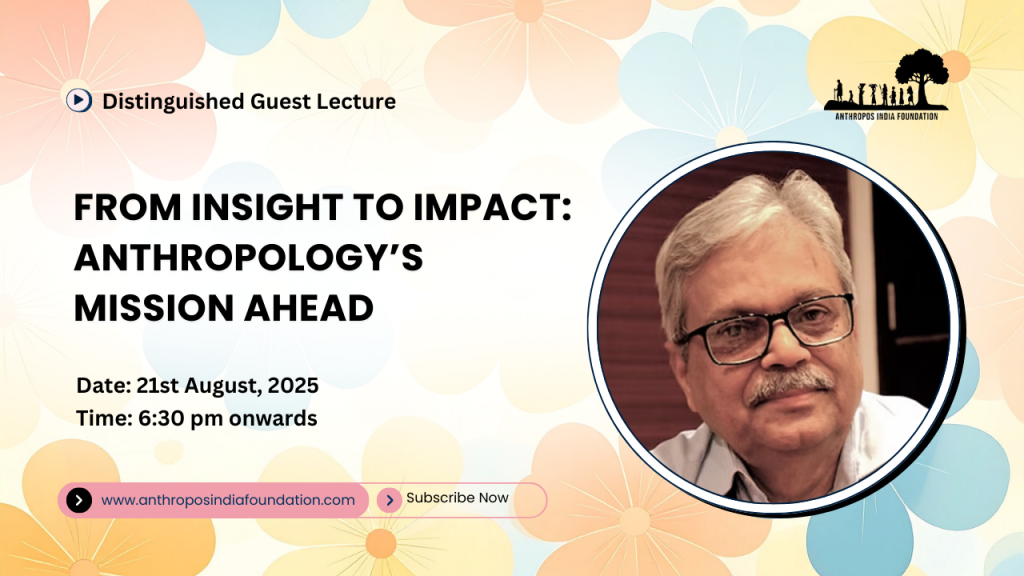
From Insight to Impact – Anthropology’s Mission Ahead | Prof. Arbind Sinha | AIF Distinguished Lecture | 21 August 2025

The lecture “From Insight to Impact – Anthropology’s Mission Ahead” by Prof. Arbind Sinha, organized by the Anthropos India Foundation as a part of their monthly distinguished guest lecture on 21st August 2025 at 6:30pm through zoom meeting and YouTube Live, focused on the need for anthropology to move beyond theory and create practical change in society. 
Prof. Sinha explained that anthropology should not remain restricted to academia but must engage with real communities, helping address issues such as health, education, development, livelihoods, and disaster management. He emphasized the importance of the local perspective (emic view), where communities’ own culture and voices shape any intervention. This bottom-up approach, he argued, ensures trust, sustainability, and meaningful impact. A key theme of the lecture was the use of visual anthropology – films, photography, and digital storytelling – as a way to make complex social realities more visible and to amplify the voices of marginalized groups. Prof. Sinha also highlighted the need for training and capacity building for young anthropologists. He suggested that along with theories, students should gain skills in research methods, communication, and digital literacy, preparing them to work effectively in both field research and policy-making spaces. His own experiences at ISRO, MICA, and other institutions showed how anthropology can successfully link insight with practice.
In his concluding remarks, Prof. Sinha outlined a vision for the future of anthropology. He emphasized the need for participatory and ethical approaches, where communities are engaged as active partners rather than passive subjects of research. He highlighted that anthropology should be transformative—informing policy, empowering communities, and addressing real-world challenges—rather than remaining confined to academic debates. By bridging knowledge with action, he noted, the discipline can truly move from insight to impact, serving as a catalyst for positive social change in India and beyond. The session concluded with an engaging Q&A, attended by experts, scholars, and students from institutions such as the University of Hyderabad, Utkal University, IBRAD Kolkata, ICMR-NARI, IGMRS Bhopal, Vidyasagar University, Nagaland University, and the Anthropological Survey of India. In total, 34 participants joined via Zoom and 78 via YouTube Live.
Past Events, Uncategorized

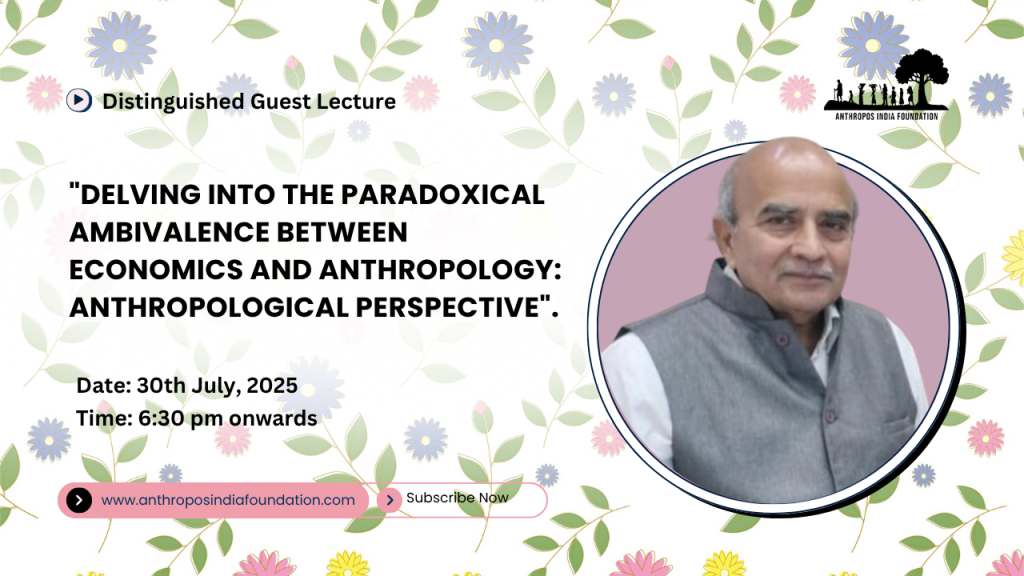
Delving into the Paradoxical Ambivalence between Economics and Anthropology: Anthropological Perspective | Prof. P. Venkata Rao | AIF Distinguished Lecture | 30 July 2025

Prof. P. Venkata Rao is a distinguished anthropologist with extensive academic and
research experience. He holds a Ph.D. from Andhra University and taught in the
Department of Anthropology at the University of Hyderabad for nearly four decades,
retiring as Senior Professor. His expertise spans the Anthropology of Development,
Tribal Studies, Complex Societies, and Ageing. He has served as Head of the
Department, Dean of the School of Social Sciences, and Coordinator of UGC-SAP.
Prof. Rao has authored six books, published over seventy research papers, and
guided numerous Ph.D. and M.Phil. scholars. A recipient of the UGC Research Award,
he currently serves as the editor of The Eastern Anthropologist and has led several
national and international research projects. His work reflects a lifelong commitment
to socially relevant and policy-oriented anthropological research.

Past Events, Uncategorized

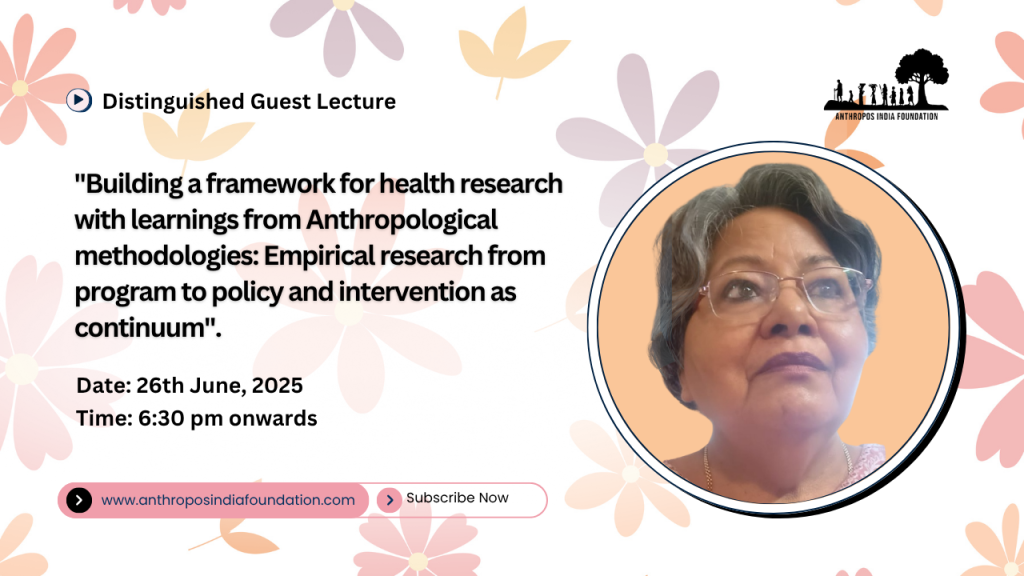
Building a framework for health research with learnings from Anthropological methodologies: Empirical research from program to policy and intervention as continuum | Prof. Nita Mawar | AIF Distinguished Lecture | 26 June 2025

Dr. Nita Mawar is a distinguished anthropologist with a PhD in Anthropology and Bioethics from the University of Delhi and a PG Diploma in Bioethics from IGNOU. She served as Director In-Charge and was a founding member and Head of the Social and Behavioural Research Division at ICMR-NARI, Pune, from its commencement in 1992 until her retirement in 2014.

Her work has focused on tribal health, women’s and children’s health, and the social and behavioural dimensions of HIV/AIDS. She has led numerous national and international research projects with organizations like NACO, WHO, and NIH-Yale, and has over 50 academic publications.

A lifelong member of UWA Pune, she has held leadership roles in IFUWA and GWI. Post-retirement, she remains active through teaching, serving on ethics committees, mentoring young researchers, and advocating for community health and research ethics.

She is also a life member of Indian Anthropologist and the International AIDS Society, a regular reviewer of conference papers for the Forum for Ethical Research and UIAF, and has contributed to planning four panels at the WAC 23.

Past Events, Uncategorized

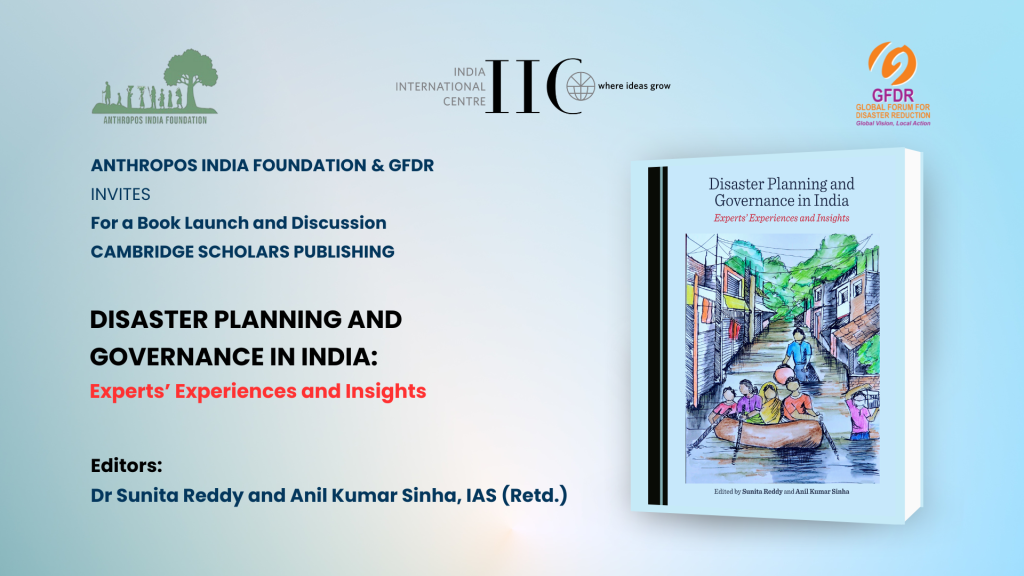
DISASTER PLANNING AND GOVERNANCE IN INDIA: Experts Experiences and Insights Book Launch & Discussion

The book launch event, “Disaster Planning and Governance in India: Expert’s Experiences and Insights” was held on Tuesday, May 27th 2025, at India International Centre (IIC) at 5:30pm. The book is co-edited by Dr. Sunita Reddy and Shri Anil Kumar Sinha, bringing together knowledge and firsthand experiences from India’s evolving disaster management landscape.
The evening began by a formal welcome by Dr. Usha Mujoo Munshi, Chief Librarian at IIC. Dr. Anshu Sharma, Co-founder of SEEDS Technical Services, moderated the session, opening with a tribute to Shri P.P. Srivastava, who was a key figure in India’s disaster management efforts which was then followed by the felicitation of dignitaries.
Prof. Ian Davis, an eminent scholar and Visiting Professor at Kyoto, Lund and Oxford Brookes Universities, joined online to appreciate the efforts by the contributors and share his perspective. He emphasized the importance of integrating local knowledge with global frameworks for disaster resilience and appreciated India’s growing capacity in disaster governance.
The event started by featuring reflections from the book’s editors:
● Dr. Sunita Reddy, Associate Professor at JNU and Founder Chair of Anthropos India Foundation, shared her insights on the significance of the book in filling a crucial gap in disaster studies literature. She enlightened us with her journey from the ideation of the book to the publishing.
● Shri Anil Kumar Sinha, IAS (Retd.), Former Vice Chairman of BSDMA, elaborated on the motivation behind the book, highlighting the need for accessible resources that combine academic rigour with field-based knowledge.
An insightful address by Prof. Dhananjay Singh, Member Secretary at ICSSR, followed. He stressed the importance of policy-oriented research in disaster governance and the role of collaborative academic-practitioner efforts in shaping effective disaster policies.
The author’s reflections session featured contributions from:
● Dr. R.K. Bhandari, Fellow of the Indian National Academy of Engineering,
● Shri K.M. Singh, Vice President of Policy Perspective Foundation,
● Prof. V.K. Sharma, Senior Professor at IIPA and Vice Chair of the Sikkim State Disaster Management Authority.
They discussed India’s journey in disaster management, from reactive approaches to proactive risk reduction, community engagement and institutional strengthening. They underscored challenges like resource constraints, the need for interdisciplinary capacity building and the integration of disaster planning into broader development frameworks.
The session also saw insights from Shri A.K. Mangotra, IAS (Retd.), former Secretary (Border Management), DG (DGSSD) and Dr. Chandrani Bandyopadhyay Neogi, Associate Professor, Department of Urban Planning, SPA Delhi, who emphasized the role of spatial planning in building resilient urban systems.
An open house session followed with the audience engaging with the speakers in a lively Q&A.
The event concluded with closing remarks by Dr. Sunita Reddy and Shri Anil Kumar Sinha, who reiterated the need for a holistic, inclusive and context-specific approach to disaster governance in India. Dr. Anshu Sharma delivered the vote of thanks, acknowledging the contributions of all speakers, authors and attendees. The book stands as a critical resource, combining policy insights, field experiences and academic perspectives to guide future disaster management efforts in India.

Past Events, Uncategorized

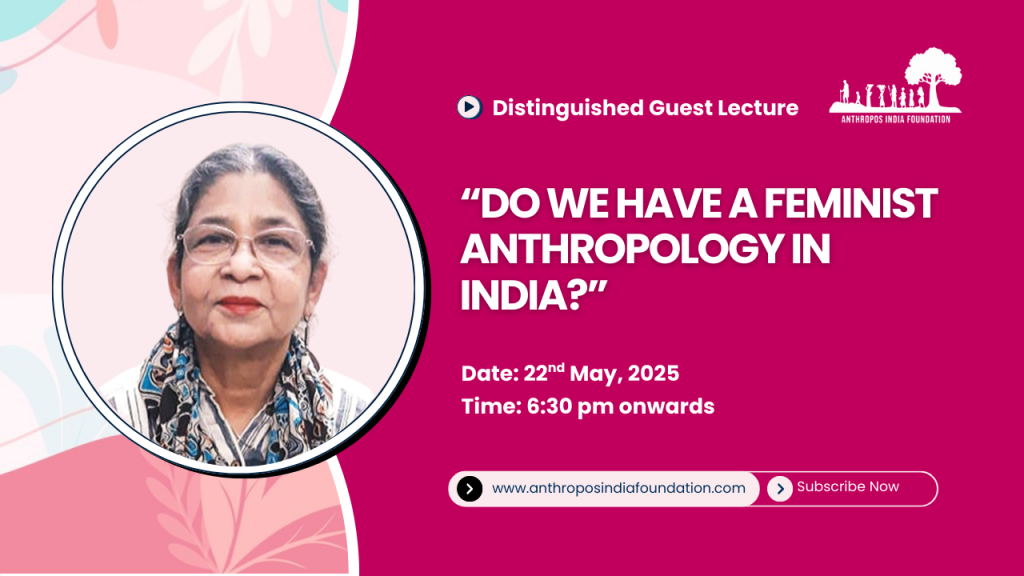
Do we have a Feminist Anthropology in India? | Prof. Subhadra Channa | AIF Guest Lecture Series | 22 May 2025

Prof. Subhadra Channa delivered a distinguished lecture titled “Do We Have a Feminist Anthropology in India?” under the AIF Distinguished Guest Lecture Series. Introduced by Prof. Sunita Reddy and Dhuri Saxena, Prof. Channa explained that during the period starting from the Second World War, feminism as a movement started developing in European countries, the Western world, and even India. Women started to realize their helpless position and how they have been exploited for generations because of their gender construction and roles.

Unlike feminism or women’s studies, Prof. Channa explained, feminist anthropology is a method that dismantles how knowledge is created and who controls it. She highlighted its rise in the 1990s, when scholars began challenging the “white male” perspective that long dominated anthropology, often sidelining women’s contributions. As an example, she pointed to Indian scholar Iravati Karve’s feminist take on the Mahabharata, which reimagined epic narratives through a gendered lens.

Prof. Channa also unpacked the evolving concepts of “woman” and “gender.” Early discussions, she noted, treated “woman” as a universal category, but marginalized groups like lower-caste women in India pushed back, revealing gender as a social construct rather than a fixed identity. She credited anthropologist Margaret Mead for showing that “biology is not destiny,” a phrase that drew nods from the audience.

Indian scholars, such as Leela Dube, have further enriched the field, Prof. Channa said, by challenging Western male-female binaries and emphasizing India’s unique gender roles tied to family and cultural traditions. In India, gender isn’t just about being a man or woman, it’s about being a mother, sister, or daughter, she told the crowd, underscoring the interplay of gender and kinship.
Then talking about culture Prof. Channa explained how culture for men and women are not the same, it is a different experience for both the gender.

The lecture also tackled anthropology’s historical bias toward studying “the other” from a privileged perspective. Prof. Channa noted that feminist anthropologists, often seen as outsiders themselves, have reshaped the field by highlighting women’s overlooked roles in classic studies, like those by Bronisław Malinowski.

As the lecture came to an end, Prof. Channa’s talk left a clear message that feminist anthropology isn’t just about studying gender but it’s about rethinking how we understand the world. It’s more about how we perceive the conceptualized roles of women and men rooted in patriarchy. Attended by approx. 44 participants via zoom meeting and 112 participants via YouTube Live from various universities such as DU, Savitri Bai Phule Pune University, Indra Gandhi National Tribal University, University of Allahabad, Utkal University, University of Kashmir, Assam University, BHU, Dibrugarh University Hyderabad University, University of Edinburgh, etc. the lecture, sparked lively discussions among attendees, signalling its impact on India’s academic and social landscape.

Past Events, Uncategorized

Weaving Indigenous Knowledge into the SDG Narrative: Whispers from the Field by – Prof. K. K Misra (24 April 2025)

Prof. Kamal K. Misra, Ph.D., is an eminent Indian anthropologist with over four decades of distinguished academic, research, and administrative experience. He currently holds the position of Professor Emeritus of Anthropology at KISS Deemed to be University (KISS-DU), Bhubaneswar. He formerly served as Vice-Chancellor of Utkal University of Culture and was the Dean of the School of Social Sciences, University of Hyderabad. He has also held several other prominent positions, including Director of the Anthropological Survey of India, Kolkata, and Director of the National Museum of Mankind (Indira Gandhi Rashtriya Manav Sangrahalaya), Bhopal. Prof. Misra has made significant contributions to cultural and social anthropology, with a deep focus on Ecological Anthropology, Linguistic Anthropology, Anthropological Theory and Museum Anthropology. He has authored and edited 27 impactful books and more than 75 research papers. He has also been involved with national-level policy-making, serving on the High-Level Committee on Scheduled Tribes of India. In addition to his administrative leadership, Prof. Misra has held academic positions in prestigious institutions in India and abroad, including Austin College in Texas, USA; University of Bergen, Norway, etc. He is a Life/Founding Member of many anthropological associations/societies in India and abroad, including Anthropos India Foundation (AIF).

Past Events

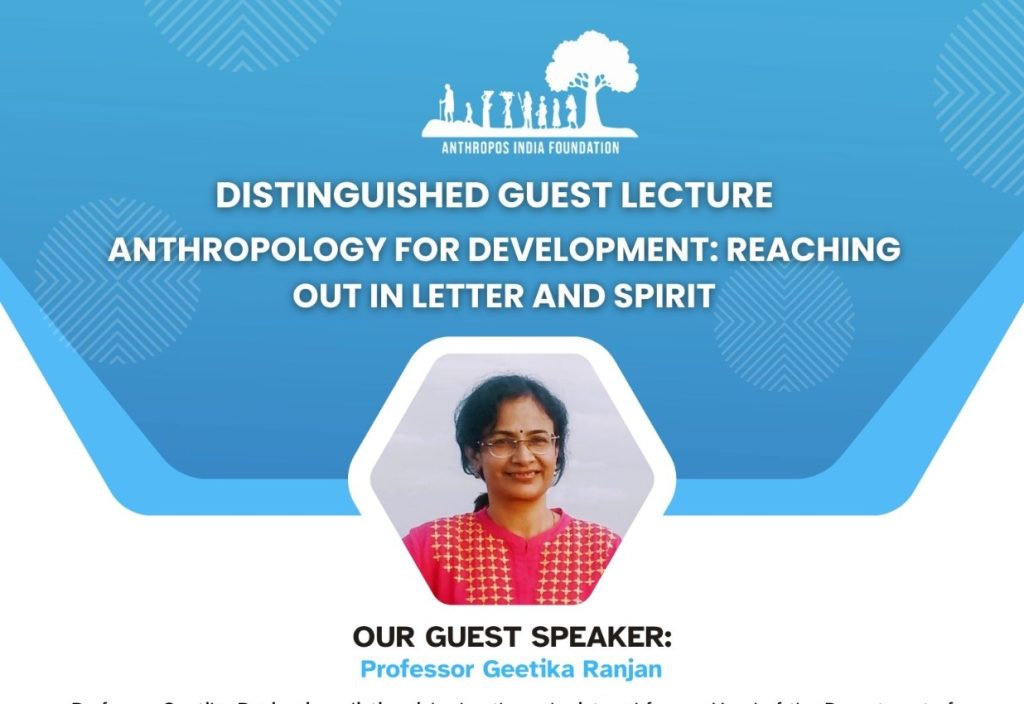
ANTHROPOLOGY FOR DEVELOPMENT : REACHING OUT IN LETTER AND SPIRIT – Professor Geetika Ranjan

Anthropos India Foundation organized a very interactive and thought-stimulating lecture by Prof. Geetika Ranjan, a well-known anthropologist with a wide range of research in political anthropology, childhood studies, and tribal society. The lecture delved into the role of anthropology in development using the framework of meticulous ethnographic studies, critical thought, and ethical involvement. Prof. Ranjan stressed the integrated nature of the discipline, using notable anthropologists whose works are still defining development. She emphasized the pioneering work of Bronislaw Malinowski in ethnographic fieldwork using his intensive studies in the Trobriand Islands, as presented in “Argonauts of the Western Pacific.” D.N. Majumdar’s M.A.R.C. (Man, Area, Resource, Cooperation) approach was also debated as an innovative model for tribal development in India. L.K. Mahapatra’s critical evaluation of displacement policies, specifically his support for displaced tribal populations, was presented as a relevant instance of applied anthropology. Prof. Ranjan also commented on S.C. Dube’s “India’s Changing Villages” and Irawati Karve’s ethnographic study of the social effects of the Koyna Dam displacement, highlighting how such studies are exemplars of the ability of anthropology to shape policy and promote participatory development.

Past Events

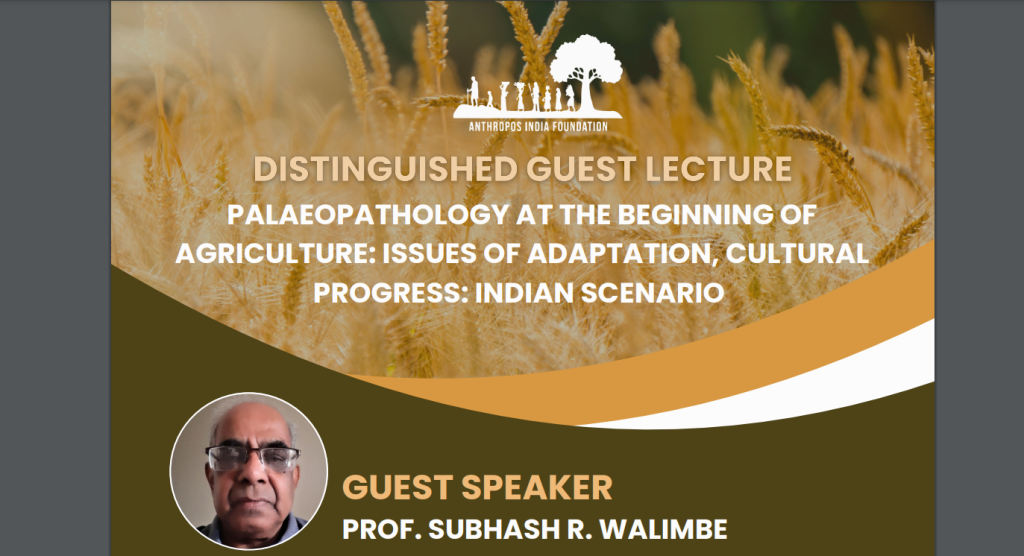
PALAEOPATHOLOGY AT THE BEGINNING OFAGRICULTURE: ISSUES OF ADAPTATION, CULTURALPROGRESS: INDIAN SCENARIO -By PROF. SUBHASH R. WALIMBE

Professor Subhash Walimbe, a retired faculty member of Deccan College Post-Graduate
and Research Institute, Pune, is a leading expert in human skeletal biology and
bioarchaeology. With over four decades of research, he has played a key role in shifting
Indian skeletal studies from racial typology to a bio-cultural approach. His work has
significantly contributed to understanding population movements in South Asia,
challenging the Aryan Invasion Theory and demonstrating genetic continuity over
10,000 years.

Past Events

Anthropology & Museums In India From The Colonial Period To The Contemporary Times By Prof Kishor Kumar Basa – AIF Guest Lecture Series (23 Jan 2025)

Prof. Basa completed his Ph. D. in Archaeology from the University of London and was a Commonwealth Academic Staff, Post Doctoral Fellow at the University of Cambridge. A former Head, Department of Anthropology, Utkal University, Prof. Basa has the rare distinction of heading seven leading organisations of the country, which include Indira Gandhi Rastriya Manav
Sangrahalaya (Bhopal), Indian Museum (Kolkata), Anthropological Survey of India, Maharaja Sriram Chandra Bhanja Deo University (Baripada), Fakir Mohan University (Balasore), Archaeological Survey of India and National Monuments Authority. Recipient of two Gold Medals – the Surajmal Saha Memorial Gold Medal and Prof. Ghanshyam Das Memorial Gold Medal, Prof. Basa was also a Tagore National Fellow, Ministry of Culture. He has delivered 12 memorial lectures in various parts of the country, has published widely in the fields of anthropology, archaeology and museum studies. He has excavated the sites of Malikhoja, Bang-Harirajpur and Gouranga Patana in Odisha, and is the Founder Editor of the journal Humankind. At present, he is the Chairman, Indian National Confederation and Academy of Anthropologists (INCAA), and Chairman of National Monuments Authority.

Shopping Cart
Scroll to Top