

Summary:
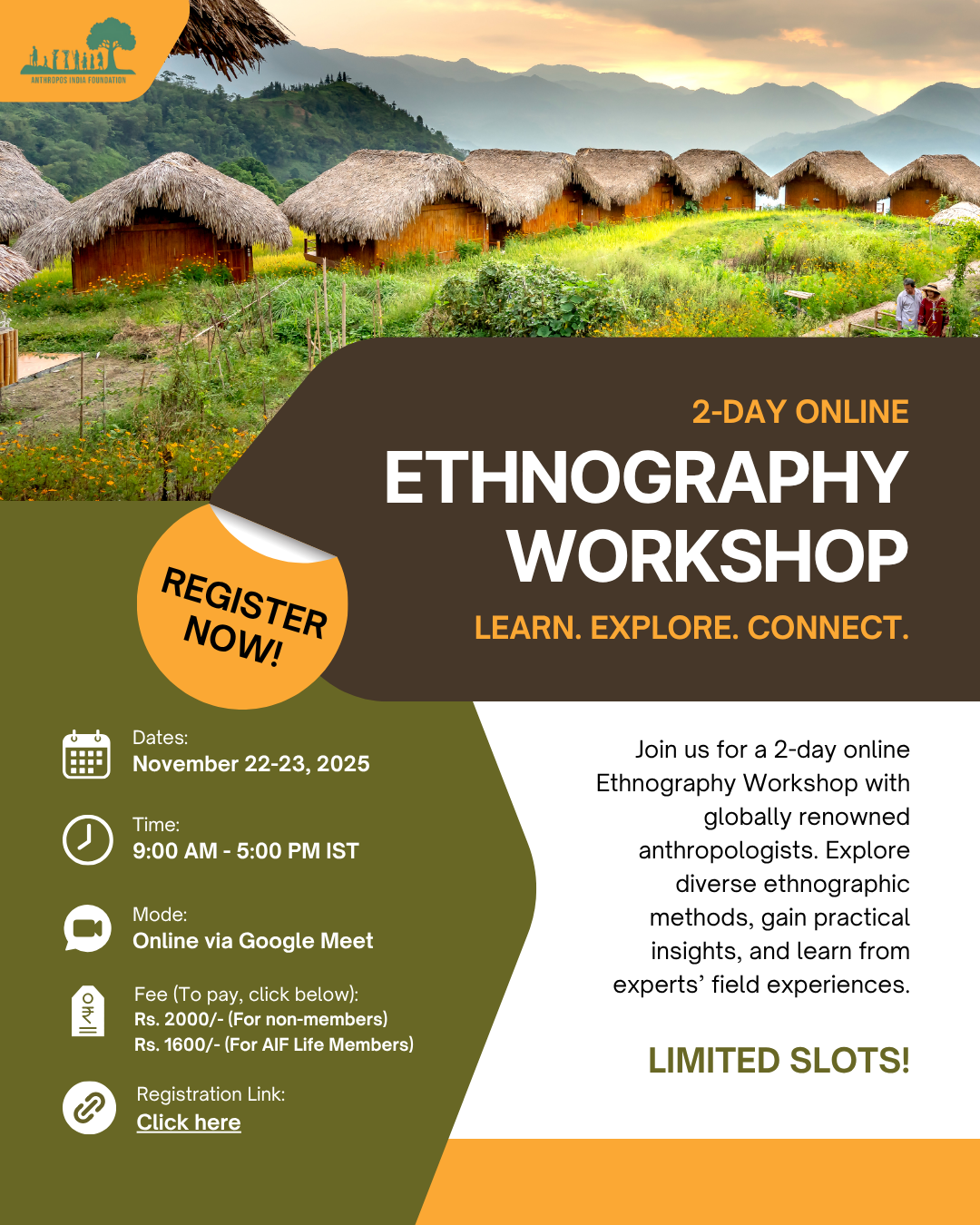
The 2-day online Ethnography Workshop on 22nd and 23rd November, 2025 organised by Anthropos India Foundation (AIF), attended by scholars, students, and professionals from different parts of India, exploring diverse ethnographic methods, gaining practical insights, and learning from experts’ field experiences.
Dr.Sunita Reddy welcomed the participants and explained the aim of the workshop introducing different approaches within ethnography and helping young scholars understand both classical and contemporary field methods. As the first session of the workshop, she defined ethnography in a direct way: studying people in their natural settings through long-term immersion.
She went over basic concepts—participant observation, building rapport, reflexivity, and maintaining field diaries.
She repeatedly emphasized that ethnography is both the fieldwork and the written output.
She also discussed practical difficulties like negotiating access, bias, emotional involvement, and working in stratified societies.
Session by Dr. Stephen Christopher
He shared practical experiences from fieldwork in Himachal Pradesh, Japan, and Vietnam.
He explained the difference between fieldnotes and final ethnography, noting that fieldnotes are usually rough, incomplete, and written quickly.
He highlighted issues of insider/outsider positions, the importance of silence in interviews, and the usefulness of photo elicitation and “go-along” interviews.
Session by Dr. Mitoo Das
Dr. Mitoo Das’s session focused on how digital spaces have become real ethnographic fields. She explained that online interactions—hashtags, “seen” receipts, deleted messages, emojis, late-night voice notes—carry cultural meaning just like gestures or silences in physical settings. Her emphasis was on reading digital behavior carefully, understanding how people express emotions online, how platforms shape what we share, and how access, privacy, and anonymity differ in India. She also stressed ethical responsibility, constant reflexivity, and the fact that the digital world is not separate from everyday life but deeply woven into it.
Session by Dr. Alison Kahn
Her session focused on applying ethnography to study Artificial Intelligence. She explained her work on a “museum of AI cultures.”
Her main point was that AI systems lack embodied and cultural grounding, which is why anthropologists should be cautious when interpreting AI-generated content.
She introduced ideas like Humboldt’s synthesis, Turner’s uncertainty, and Geertz’s “thick description” to explain how ethnographic thinking can help understand the social impact of AI.
She also advised scholars to practice self-care and avoid depending excessively on AI tools for academic work.
Day 2:
Session by Prof. G. Kanato Chophy:
He spoke about connecting ethnographic micro-studies to larger regional frameworks.
He explained how studying only one village or community is not enough for understanding broader cultural patterns.
Using examples from Northeast India, he introduced concepts like the “Baptist Highland” and the “Brahmaputra–Chinwin culture complex,” showing how cultural connections cross national boundaries.
He emphasized that young researchers must learn to develop conceptual frameworks, not only collect descriptive data.
Session by Dr. S. B. Roy
His session focused on “scientific ethnography” for tribal development.
He listed four essential elements:
1. Participant observation
2. Understanding culture and institutions
3. Studying people in their natural environment
4. Co-adaptation
He also explained a seven-step method for applying ethnographic findings to real development programs, with examples from Odisha and West Bengal.
He stressed observing natural resources, rituals, and community organization as part of ethnographic analysis.
Session on Autoethnography (Dr. Archana Kaushik)
She described autoethnography as using one’s own life experiences as data.
She clarified the difference between autobiography and autoethnography, highlighting that the latter always links personal experience to wider culture and society.
She encouraged participants to write honestly about experiences, especially when dealing with sensitive topics like illness or trauma.
Overall Observations
The workshop covered classical ethnography, digital ethnography, regional studies, and autoethnography.
Each speaker brought examples from their own fieldwork, which made the sessions practical and not only theoretical.
A recurring theme across sessions was the importance of reflexivity and the need for clear conceptualization in research.
Discussions were interactive, with participants sharing doubts and field challenges.
Conclusion
The two-day workshop provided a clear overview of ethnographic methods, their applications, and the current challenges faced by researchers. The sessions collectively emphasized careful observation, ethical research, conceptual clarity, and the importance of linking individual case studies to broader social processes.