

Summary:
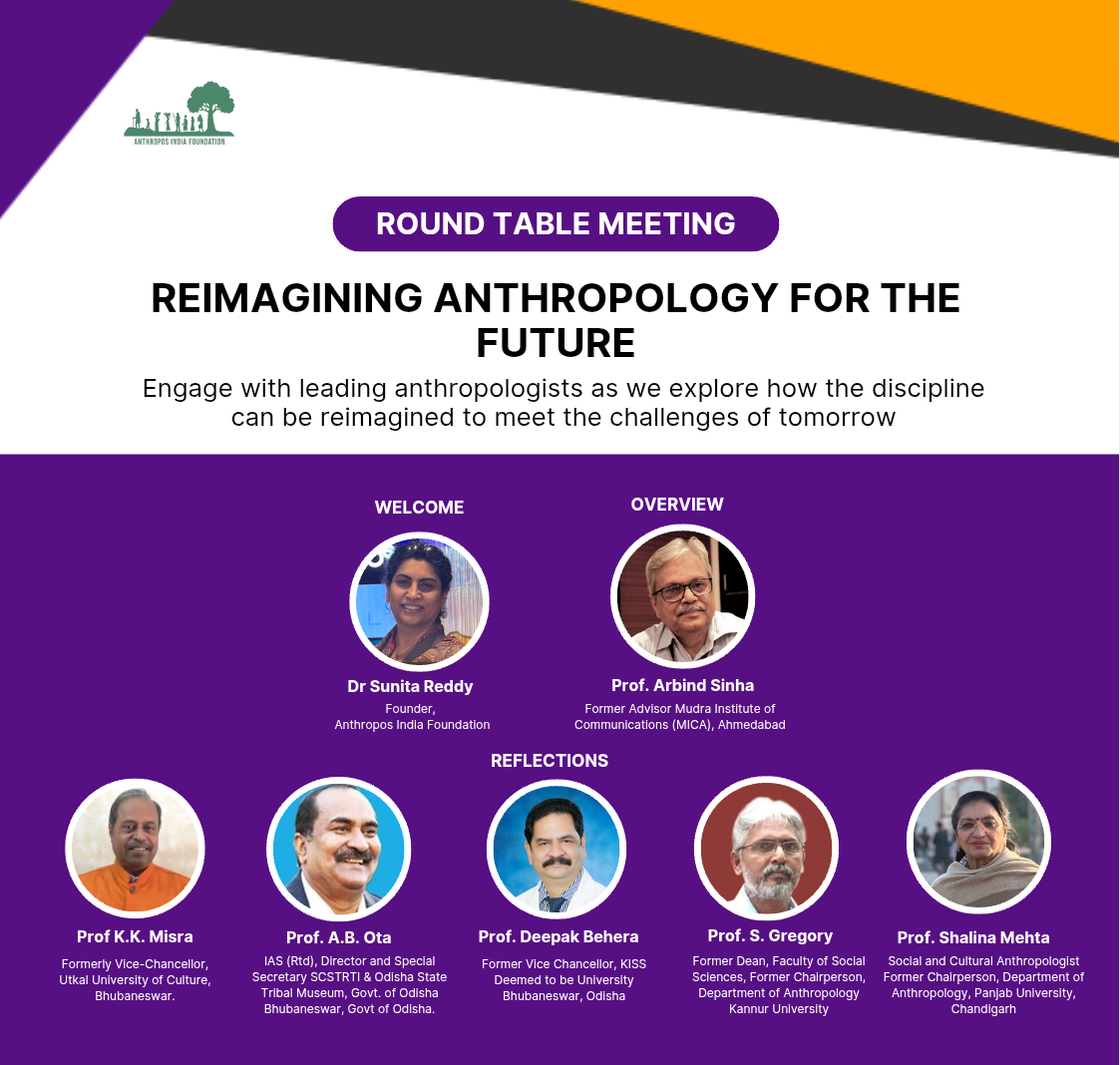
On the 23rd of September, Anthropos India Foundation organized a Round Table Meeting on Zoom, entitled ‘Reimagining Anthropology for the Future’, chaired by Dr. Sunita Reddy and led by Professor Arbind Sinha. Featuring reflections from acclaimed anthropologists such as Prof. Deepak Behera, Prof. S. Gregory and Prof. Shalina Mehta, the session sought to not only contextualize how both the discipline of anthropology and its manner of academic instruction in India must be reconstituted to address contemporary concerns and challenges but also examined what it means to study and apply anthropology, why one must ‘think anthropologically’ and how the collective efforts of anthropologists and institutions can reorient the status quotient.
The round table meeting had an audience of over 45 members through Zoom and over 125 individuals on Youtube Live. Attendees affiliated with several eminent institutions were a part of this session, including students from the University of Delhi, the University of Calcutta, the University of Madras, Indira Gandhi National Tribal University, the University of Hyderabad and the Central University of Rajasthan, among others. The session also welcomed anthropologists and scholars from the Anthropological Survey of India, Indian Council of Social Science Research (ICSSR), Indira Gandhi Rastriya Manav Sangrahalya, DR Rao’s Research and Development Welfare Society and Karnataka State Tribal Research Institution, among other research and policy institutions.
After Dr. Sunita Reddy’s welcome address, Professor Arbind Sinha commenced the session by proposing an action plan to institute a prominent university department as a centralized nodal agency for anthropological research in India, led by an acclaimed senior faculty. Declaring the current round table meeting as the first of five consecutive sessions, Professor Sinha called for the formation of an advisory committee which shall network with governmental and non-governmental organizations, both national and international, structure research outputs (particularly for younger scholars) and source funding, relevantly addressing the status of anthropology in a cosmopolitan world.
Professor Sinha recognized that the primary challenge faced by anthropologists in India is the prominent gap between expectations and occupational and/or research realities, that must be bridged across multiple levels of analysis. Despite historically regarded as central to policy planning and development, particularly in relation to marginalized communities due to the practise of ethnographic fieldwork, anthropology in India finds itself plagued by concerns of declining institutional enrolments, reduced occupational output and inter-subject fragmentation; Prof. Sinha attributing this to curricular and policy gaps reflected in limited applied opportunities, job-oriented modules and a lower number of universities supporting anthropology as a course at the bachelors or masters level.
Therefore, Professor Sinha proposed a five-phased methodology (Desk research, Field consultation, Data Analysis, Dissemination Seminar and Recommendations) constructed through nationwide surveys of universities and departments categorized by specialization and strength, a curriculum gap analysis as well as an assessment of employability opportunities across diverse domains in order to analyze market feasibility in administration, research and advocacy, establishing a futuristic sectoral-oriented framework. Expected outcomes within the framework for repositioning anthropology include the formulation of an all-expansive departmental directory of anthropology, a comparative curriculum report and gap analysis to benchmark against other allied disciplines, a sectoral analysis of employability, pilot testing and dissemination for validity and the provision of structured internships and job modules within departments; the discipline’s centrality to social change and policy formulation is re-established as theoretical instruction aligns with employment realities.
Following Dr. Sinha, Professor Gregory expanded further upon the issues faced by anthropology based upon his experiences in Kerala, proposing an eight-step outline on reformulating anthropological instruction and application for the future as well as focusing upon the integration of anthropology in senior secondary curriculums. Professor Gregory succinctly addressed domains of the dilemma of anthropology’s identity as a discipline, associated academic visibility and enrolment demand, comparative social relevance, ethical issues associated with anthropological research and its non-inclusion in policy reforms, academic networking at macro and micro levels of administration and dissemination and placement prospects for anthropology graduates, among others.
Furthermore, Professor Gregory posited suggestions for the way forward, arguing for holism within the subject to be enshrined within the curriculum under the proposed Faculty of Anthropological Sciences. He also extensively discussed the importance of universalizing anthropological education at the level of schools and secondary education; the integration of anthropology within the syllabus of CBSE must also accompany placement-oriented course structures at undergraduate and postgraduate levels with the subject being integrated as elective options in allied disciplines and optional courses. Other changes suggested include encouraging analytical studies and conceptual formulas by assimilating disciplinary outputs into policy framing, disintegrating dogmatic institutional and academic hierarchies, developing cultural and policy translation centres as well as placement cells and guidance committees in order to empower budding anthropologists as well as mandating structured internships within the curriculum.
In his address, Professor Deepak Behera critiqued the curriculum dependency of anthropological education in India on outdated theories and colonial ethnographies as opposed to the theoretical integration of Indian anthropologists. He also noted the pertinent lack of meaningful engagement with allied disciplines, which contributed to the marginalization of the subject in the Indian higher education system. Calling for the re-invigoration of the subject, Prof. Behera posited that reformations within curriculums must restructure reading lists to feature contemporary and indigenous contributions with a focus on Indian-contextualized case studies. Training in mixed methods, digital ethnography, data analytics, policy formulation, machine learning, medical anthropology in practice and tools such as GIS and NVivo must be integrated within anthropological education. Employability opportunities can be strengthened by introducing structured internships as well as courses in cultural resource management and policy writing, particularly helpful in emphasizing the role of anthropology in introducing a human centered insight and product design within the startup ecosystem. Professor Behera concluded his address by introducing the concept of technoanthropology; anthropology in India must critically engage with the ethical issues associated with Artificial Intelligence and shape sustainability discourse.
Professor Shalina further contributed meaningfully to the discussion by contextualizing the status of anthropology in India through the purview of her professional career as an anthropologist in Panjab University. Other eminent anthropologists such as Dr. Rajni Lamba and Prof. S Chowdhury expressed the need for anthropologists to advocate the utility of the subject in diverse domains, with Professor S.B.Roy contextualizing the application of anthropological theories within a ‘demand and supply’ configuration with reference to students.
The session concluded poignantly, with young scholars enriching the discourse and expanding on aspects such as institutional challenges, the need for anthropology to be regarded as eligible within fields of community management and the utility of comprehensive surveys.