

Summary:
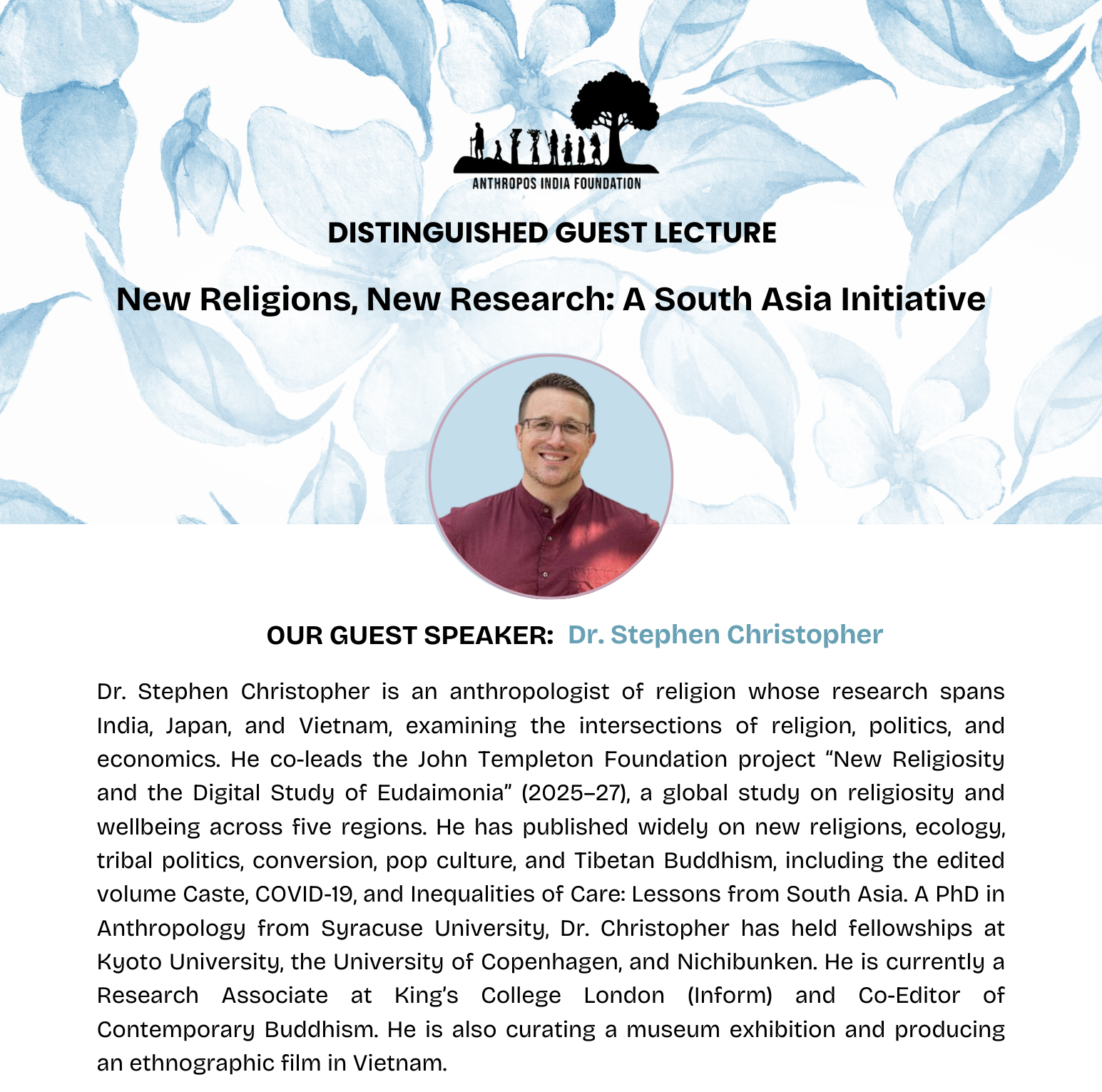
Dr. Stephen Christopher, an anthropologist of religion, presents a distinguished guest lecture on a new research initiative focused on new religions in South Asia, organized by the Anthropos India Foundation. His lecture outlines his extensive academic work, which includes research in India, Japan, and Vietnam, and his involvement in a global study titled “New Religiosity and the Digital Study of Eudaimonia.” This project, backed by a significant grant of $1.6 million, aims to create the largest open-access dataset on new religious movements, covering groups such as ISKCON and Osho.
The lecture emphasizes the importance of understanding the dynamics of new religiosity and its intersection with well-being, particularly how minority religions arise amid majority interests. Dr. Christopher shares his academic background, detailing his PhD in anthropology from Syracuse University and his extensive fieldwork in India, where he explored the Gadi tribe and reservation politics. His research also includes post-doctoral studies on Tibetan Buddhism in Japan and Vietnam, focusing on the growing influence of this tradition in Vietnam.
A key aspect of the initiative is the development of a comprehensive research methodology that counters negative media portrayals of new religions. The project starts with a large-scale ‘new religiosities poll,’ consisting of 450 yes/no questions that assess social structures, practices, and environmental relationships rather than just beliefs. This approach aims to gather diverse data from various perspectives, including both insiders and outsiders, and will involve training citizen scientists from within religious groups to contribute to the dataset.
Dr. Christopher highlights the structured nature of the poll, which categorizes questions into different domains, such as finances, health, values, technology, and state relations. The project will also include detailed entries on religious histories, allowing for qualitative insights and expert validation to ensure data accuracy. This quantitative approach enables data visualization and analysis, helping to uncover patterns such as female leadership across different religious categories.
The lecture addresses the theoretical contributions of the research, particularly how new religiosity intersects with human flourishing. The project’s objective is to provide a balanced perspective on new religions, moving beyond portrayals of abuse and manipulation to explore their potential for well-being. Dr. Christopher focuses on the South Asian context, seeking to include 80 entries from Dharmic New Religions that have emerged or transformed significantly since the 1960s, which often possess characteristics such as charismatic leadership and digital mediation.
Dr. Christopher encourages audience participation in identifying examples of South Asian new religions, highlighting both lesser-known groups and those with existing literature. He provides examples, such as the Mahabodi International Meditation Center in Ladakh and the Omana temple in Rajasthan, illustrating the diversity of new religious movements in the region.
The initiative aims to collect data that reflects a wide range of experiences and epistemic perspectives, ultimately creating an open-access, interactive dataset that can serve scholars in empirical hypothesis testing. The project’s rigorous methodology includes a lengthy questionnaire and a double review process for poll results, contributing to the reliability and richness of the data collected.
In conclusion, Dr. Stephen Christopher’s lecture sheds light on the complex landscape of new religions in South Asia, emphasizing the need for a nuanced understanding of their societal impacts through rigorous, inclusive research methodologies. The initiative has the potential to reshape public perceptions and academic discourse surrounding new religious movements, fostering a deeper appreciation for their role in contemporary society.