

Summary:
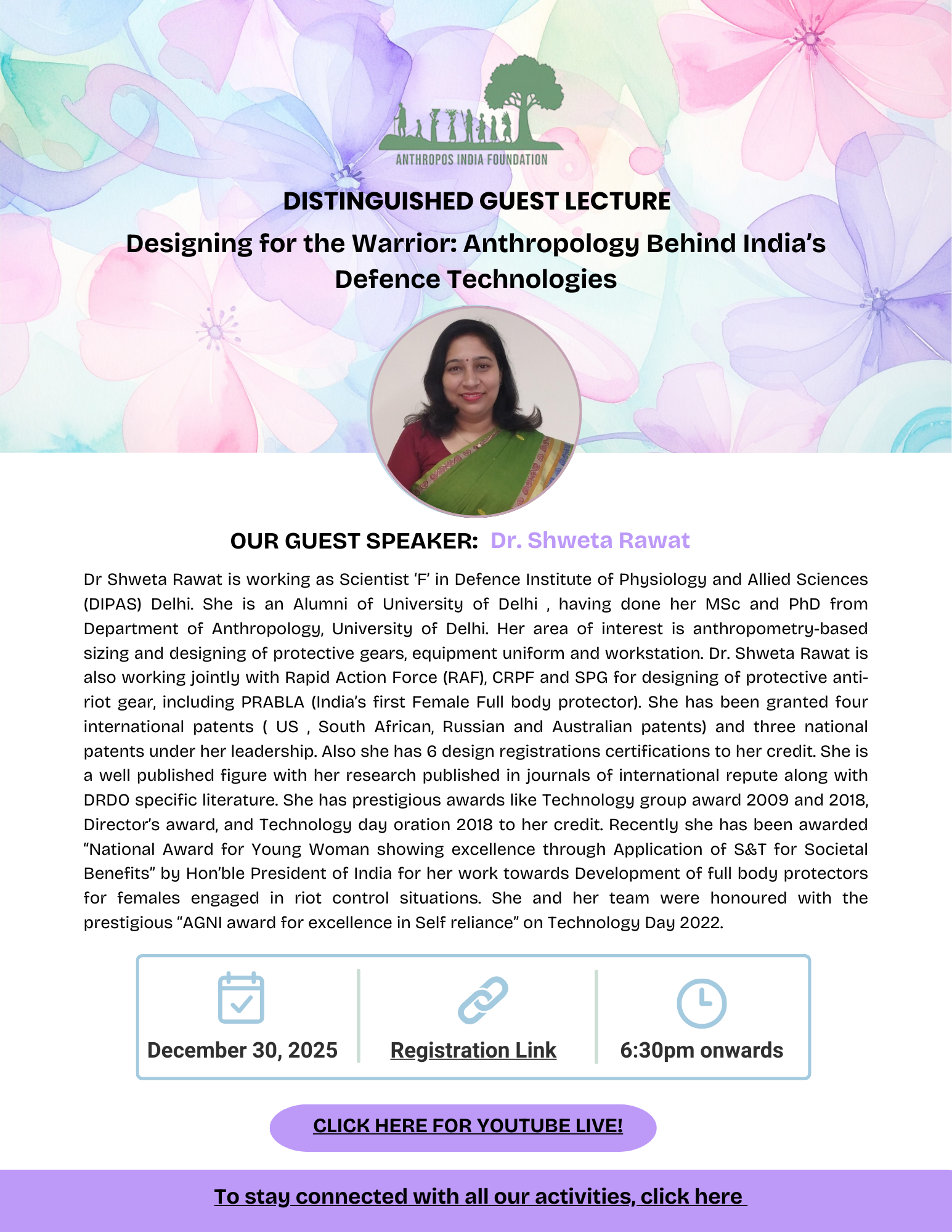
This report summarizes a Distinguished Guest Lecture delivered by Dr. Shweta Rawat on the role of anthropometry and ergonomics in India’s defence technology design. The lecture was organised by the Anthropos India Foundation as part of its Monthly Distinguished Guest Lecture Series. It was attended by approximately 50 participants via Google Meet and 40 participants through YouTube Live, with attendees joining from different parts of India. The session highlighted how human-centred anthropological research contributes directly to soldier safety, operational efficiency, and overall effectiveness in defence technology design.
Dr. Rawat explained that anthropometry—the systematic study of human body measurements—is a mandatory component of the Preliminary Design Review stage for all human-use products within the Defence Research and Development Organisation (DRDO). Given India’s biological diversity and increasing participation of women in defence roles, reliance on generic or male-centric data poses serious risks. DIPAS has therefore developed detailed anthropometric databases, moving from manual measurements to advanced 3D scanning technologies. These databases support indigenous design initiatives and align with the “Make in India” policy.
A major case study discussed was “Prabala,” India’s first female-specific body protector for riot control personnel. Previously, female troops used scaled-down male body armour, which restricted mobility and compromised safety. Prabala was designed using female anthropometric data and is fire-resistant, anti-stab, and acid-resistant. Its adoption by police and paramilitary forces, along with national and international recognition, demonstrates the success of gender-sensitive defence design.
Dr. Rawat also addressed the application of anthropometry in infantry combat vehicles, load carriage systems, and aircraft cockpits, including the LCA Tejas fighter jet. Earlier cockpit designs, based on limited male data, resulted in unsafe ejection-seat clearances. Anthropometric redesign corrected these flaws, underscoring how minor ergonomic errors can have fatal consequences in high-risk environments.
The lecture emphasized designing for extreme body-size percentiles rather than averages, particularly for emergency equipment such as escape hatches. Although full customization is difficult at scale, the Indian Armed Forces have addressed diversity through multi-size systems, including 13 uniform size categories.
Beyond defence, Dr. Rawat noted the growing relevance of anthropometry in elderly care, public safety, and general ergonomic design. She stressed the need for multidisciplinary collaboration and encouraged young scholars to enter the field, given the small number of trained anthropometrists currently active in India.
Overall, the lecture demonstrated that anthropometry is a practical and essential tool for reconstructing safer, more inclusive defence technologies, reinforcing the importance of anthropology in applied and policy-relevant contexts.