

Summary:
Report: Digital Anthropology
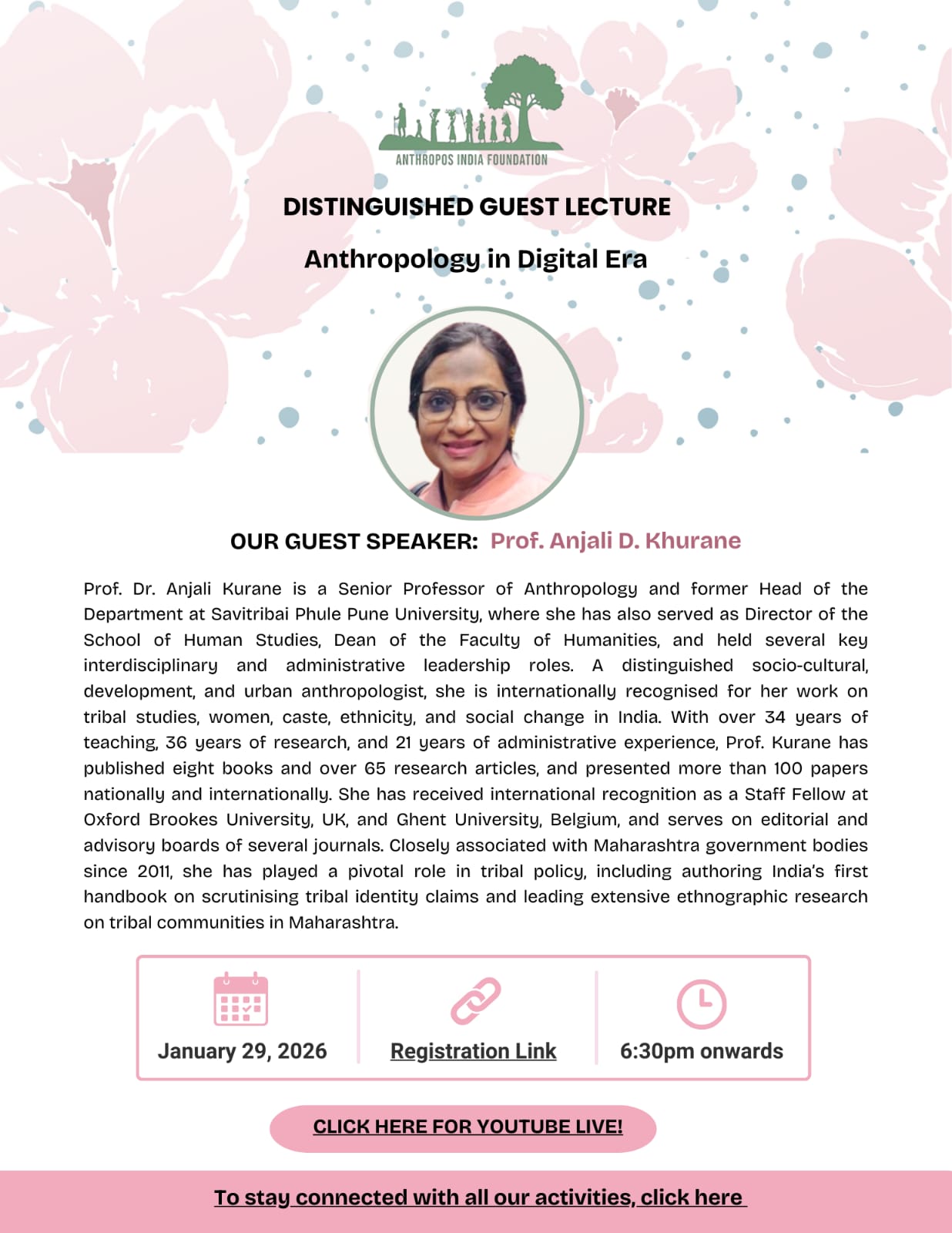
The meeting began with the announcement and digital release of the fourth issue of “Childhood Matters”, a quarterly multilingual digital magazine by Anthropos India Foundation. The meeting was attended by 47 participants via Google Meet and 51 via YouTube live. The lecture was delivered by Prof. Kurane.
Conceptualizing Digital Anthropology
Prof. Kurane emphasized that digital technology functions as a cultural environment shaping identity, kinship, power relations, and social interaction. Digital anthropology examines how platforms and algorithms reconfigure human experiences. She distinguished between big data and thick data, warning that decontextualized data can reinforce social inequalities.
Evolution of the Discipline
Anthropology has evolved from studying isolated societies to examining interconnected rural, urban, corporate, and digital spaces. Digital ethnography extends fieldwork into online networks, social media, and virtual worlds, challenging distinctions between the virtual and the real.
Methods, Ethics, and Inequality
The lecture highlighted methods such as online participant observation, network analysis, and AI-assisted data handling. Ethical concerns around consent, privacy, surveillance, and data sovereignty were emphasized, especially regarding marginalized communities. The digital divide was framed as an issue of autonomy and literacy, not just access.
Illustrative Case Studies
Examples included online gaming communities, social media activism during the Arab Spring, digital nomadism, virtual reality platforms, and virtual worlds such as Second Life, illustrating identity formation, economic practices, and collective action in digital spaces.
Concluding Reflections and Outcomes
Prof. Kurane concluded that digital anthropology is essential for understanding contemporary society. Anthropologists must interpret algorithmic cultures, expose embedded biases, and advocate for ethical digital futures. The meeting successfully linked publication, scholarship, and public engagement, reaffirming anthropology’s relevance in a digital age.